
Golisano Children's Hospital
They asked for a new website. We told them they didn’t need one.
How questioning a six-figure request led to a better outcome for patients, leadership, and the bottom line.
The ask
Golisano Children’s Hospital, a four-time Leapfrog Top Children’s Hospital and part of Lee Health, one of Florida’s largest nonprofit health systems, had a problem. In 2022, Lee Health launched a significant marketing push around children’s services. Traffic was being driven to Golisano’s primary landing page on the Lee Health site, where services, resources, and the brand story lived.
It wasn’t working. The page wasn’t converting. Leadership was frustrated. The Patient and Family Advisory Council had concerns. And the instinct from the team was swift: build a standalone children’s hospital website, separate from the health system. A fresh start.
Most agencies would have scoped the project and sent a proposal. We asked a different question first: what are you actually trying to fix?
What the data showed about their pediatric digital experience
Before recommending anything, we dug into the numbers and ran user testing. What we found wasn’t a branding problem or a content problem. It was a structural one.
A separate locations detail page was ranking higher in Google search than the primary landing page, pulling users into a dead end that lacked service information and any sense of the Golisano brand. Meanwhile, the landing page itself was rich with content but nearly impossible to navigate to from search. Users were finding the wrong door, and once inside, couldn’t find their way around.
A new standalone website wouldn’t have fixed any of that. It would have added a third door.
The conversation that mattered
We pushed back on the brief. Not to be contrarian, but because our job isn’t to take orders. It’s to understand what a client is actually trying to accomplish and find the most direct path to get there.
The goal wasn’t a new website. The goal was connecting families to the right information, fast, so they could choose Golisano with confidence. That’s a navigation and SEO problem, not a build problem.
We recommended a targeted optimization approach instead. No new CMS. No new domain. No six-figure scope creep.
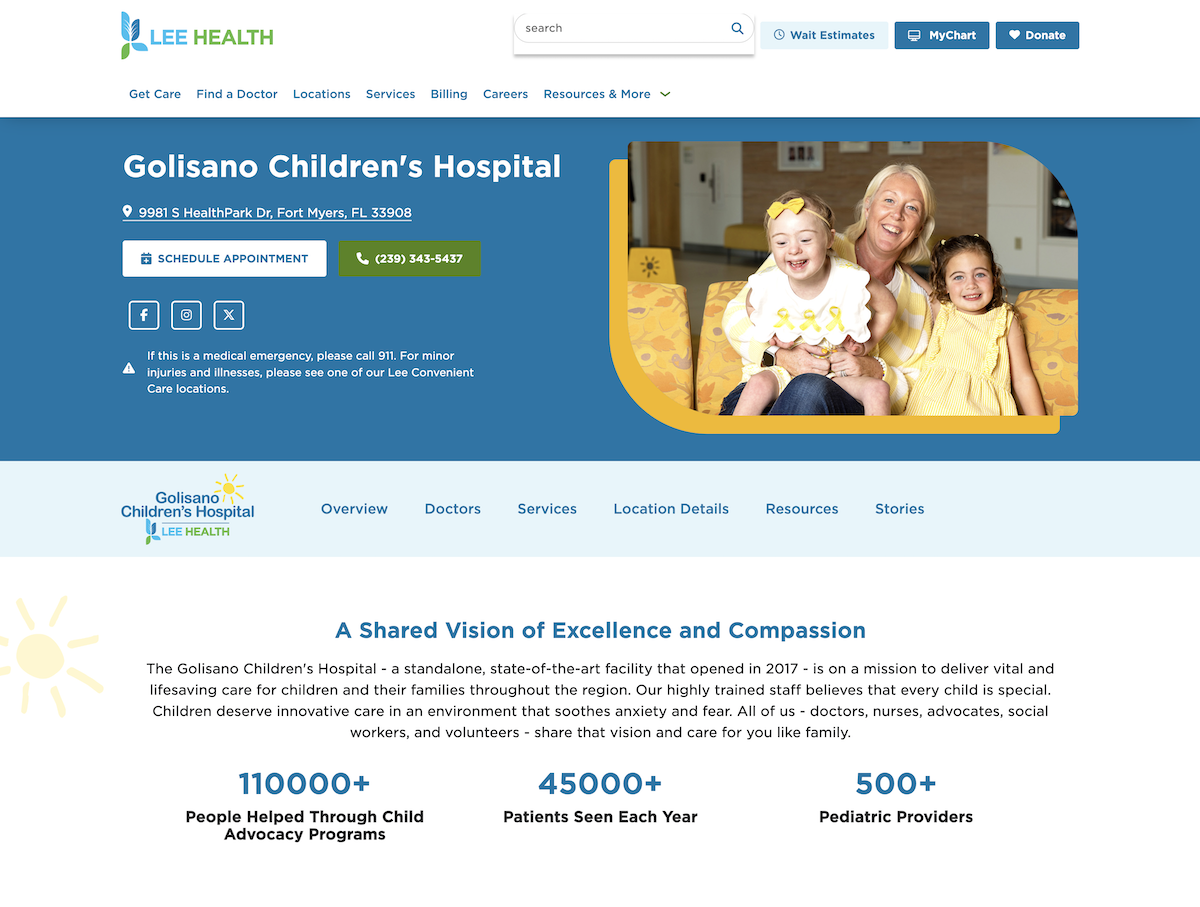
How we improved the Golisano Children’s Hospital UX
Rather than a standalone site, we created an engaging, user-friendly microsite for Golisano Children’s within the Lee Health ecosystem. The work focused on three things:
- Consolidated the fragmented landing and location pages into a cohesive microsite with a clear, intuitive user journey
- Resolved the UX and information architecture issues that were creating dead ends for families trying to find care
- Fixed the Google search results problem so users landed in the right place from the start, not partway through a maze
The result was a richer experience for families and a cleaner foundation for Lee Health’s ongoing marketing efforts, without the disruption of a full rebuild.
Results: traffic, cost savings, and SEO
- Double-digit increase in engaged traffic to children’s services
- Hundreds of thousands of dollars saved by avoiding a full new-site build.
- No disruption to existing SEO equity
More importantly, Lee Health got what they actually needed, not what they thought they needed in the moment.
What a strategic healthcare digital agency partnership looks like
This is what a continuous improvement partnership looks like in practice. Not a series of large capital projects, but an ongoing relationship where data, stakeholder input, and honest counsel drive the work. Lee Health has trusted us with that kind of engagement for over eight years, and moments like this are why.
The difference between a vendor and a strategic partner is simple. A vendor builds what you ask for. A partner tells you when you’re asking for the wrong thing.
The result:
boost in service line traffic
savings
months NOT wasted on a project